

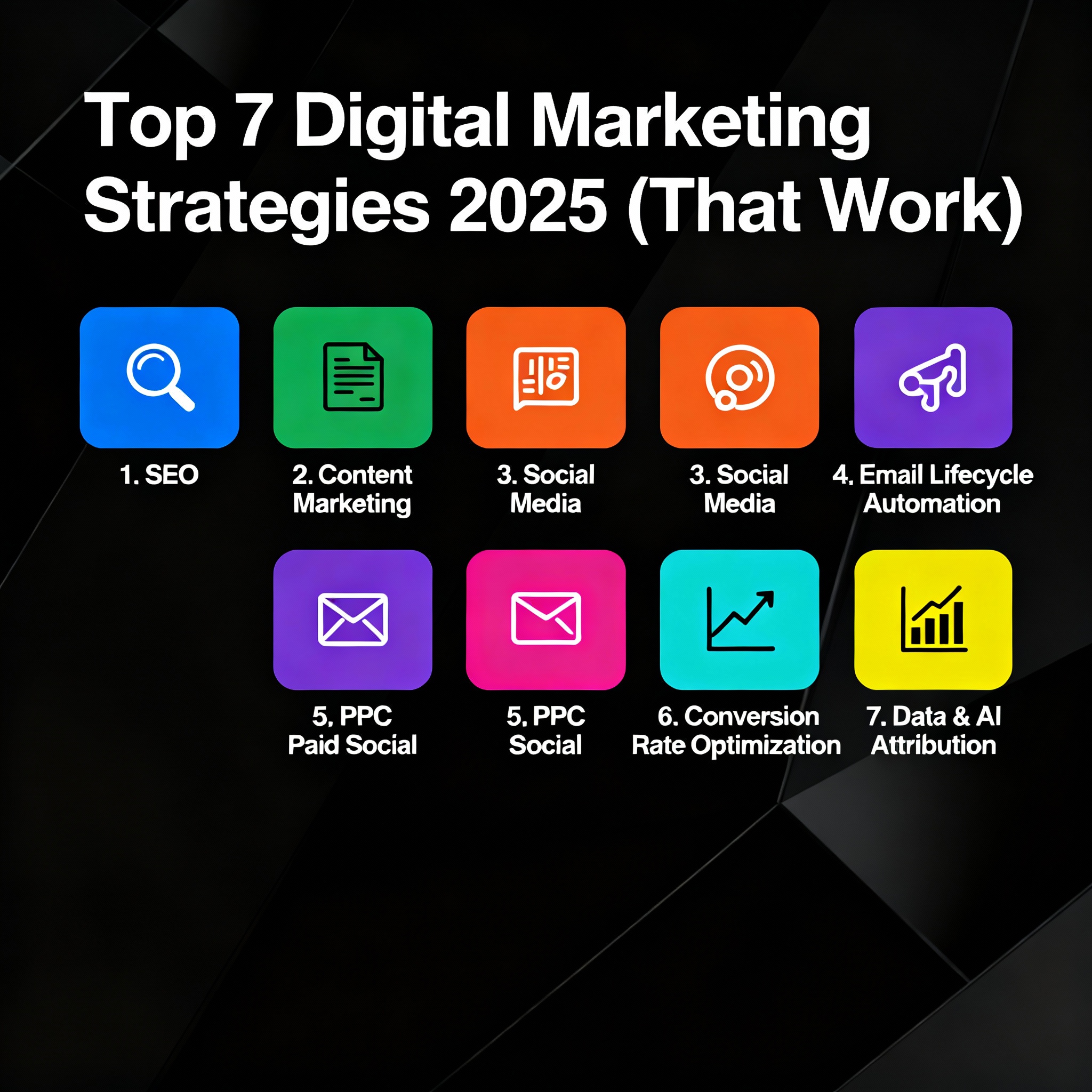
Top 7 Digital Marketing Strategies 2025 (That Work)
Key Highlights
Here are the big things to know from our guide about digital marketing strategies in 2025:
- • If you want to move up in the marketing industry, you need to be aware of new marketing trends.
- • You can get good results when you use digital channels like social media, content marketing, and SEO.
- • If you use AI in your marketing, you will be able to send messages that feel made for each customer. This can help you boost customer engagement.
- • A strong plan starts when you know your goals and when you learn about your target audience.
- • With data analysis, you can make your campaigns work better. You also get more value for your money.
Why these “Top 7” in 2025?
The plan to grow in 2025 is clear. You want people to find you. Your product should help their needs. Your site or service must be fast. You have to keep things steady so people feel they can trust you. By implementing these strategies, you can create a lasting competitive advantage. The seven ideas below work for new startups, local brands, and big companies.
These tips mix things that help slow growth, like search and using content, with things like artificial intelligence for fast results, like paid ads and changing your pages to get more sales. Each idea comes with quick tips, tools to use, and ways to check if things are working well. This way, you can get started right away.
Strategy 1: Search Engine Optimization (SEO) that focuses on experience, not just keywords
Our main goal is to get more people to come to our site from search. We want the visitors to be the right fit for what we offer and to enhance customer loyalty. They should be interested in what we have for them. Over time, we want to lower the cost to get each new customer. This will help us save money. It can also help us grow.
What to do
- • Map search intent to your pages. Use guides if someone wants information. Set up comparison pages for people who like options. Make service or product pages for those looking to buy. Use location pages when the search is local to navigate the evolving marketing landscape.
- • Build topic clusters. Start with one main hub page. Link several related articles to the main page.
- • Improve page experience. Make sure each page loads fast. Put mobile first and keep all navigation clean and easy. Link to other helpful pages on your site. Add FAQ sections to get better results.
- • Use schema markup for your articles, FAQs, and product or service pages. This helps people find you better.
Quick wins
- • Go back to five or ten old articles and update them with new numbers using digital marketing tools. Make better headings that tell what each part is about. Put links in those articles to other pages on your site.
- • Add FAQ sections and How-to guides to your top pages. This helps your pages get into People-Also-Ask spots.
- • Work on pages that feel weak. You can put them together or add new details and info to create good resources.
Tools
Search Console, Ahrefs/Semrush, PageSpeed Insights, and Screaming Frog are the main tools, alongside Google Analytics, that many people use. You can get lots of good info about your website by using them. These tools help you know how your site is working and what to do to make it better. They also show you things you might not see by just looking at your own site. Try them out to see what you learn. You can use all of these tools, or just pick the ones you feel work best for you.
Metrics
Here are some key things to watch:
- • Organic clicks show how many people get to your site from search results.
- • Non-brand impressions are when people see your pages in search results, but they do not look for your brand across various channels.
- • Top-3 rankings mean your page is in the first three search results that people see.
- • Conversions from organic happen when someone does something you want, like signing up or buying, after they come from search results.
Strategy 2: Content Marketing built around user problems (not brand features)
The main goal is to show that we know the work well and implement an effective digital marketing strategy. We want to give clear answers for things that people ask. It is also important for us to always get new clients.
What to publish
- • Solution-led guides like “How to choose...”, “Cost to...”, or “Best tools for...” help people get answers to questions many have in their marketing campaigns. You can find what you need fast.
- • Case studies with pictures and clear outcome make it easy to see the change from start to finish. Each part shows the time spent, so you know what the process looked like and how long it takes. Social media is also a good way to share these.
- • Short videos between 30 and 90 seconds show the main ideas from longer posts. People learn big things fast through social media or email, including product recommendations. It is quick and simple.
- • Downloadables like checklists, calculators, and templates give people tools they can use right away. These help with email sign-ups and give them something nice for free.
A good way to do this is to begin with some research. Make an outline next. Then write your draft. Work on the design after that. Try to make a short video snippet, too. When you get all this done, share it with people. You can also change it a bit and use it in other ways.
Quick wins
- • Take the three blog posts that you feel are the best. Then, make a PDF for each one on a single page, moving away from traditional marketing methods. Also, create a short video to talk about each blog post.
- • For the blog posts that already do well, add new things like a checklist or a page you can use for planning.
- • Change webinars into written articles, quick videos, and posts for social media.
Tools
Notion and Docs help you make outlines when you need them. To check if your text is easy for people to read, use Grammarly and Hemingway. Canva and Figma are the tools to use for creating good visuals, while generative AI tools can enhance your design process. When you want to edit videos, Descript and CapCut can be used to get it done.
Metrics
Leads from content help us see how many people like what is on the page. Assisted conversions show if the content helps them think or choose before they buy something or sign up. The average time on page shows how long users read what is there. Website traffic and email sign-ups mean that visitors want to get more updates or news from us in the future.
Strategy 3: Social Media in 2025 = short video + community + DMs
The main goal is for more people to notice the brand. It is also good to start talks that help get new leads.
What works now
- • Short videos like Reels, Shorts, and TikTok grab people’s attention with hooks in the first two seconds.
- • Keep posting a series like “Weekly Website Tear-down” or “Marketing Myth Monday.” This way, viewers know what they will get.
- • Work with other creators and micro-influencers. It is better to be real than to act perfect.
- • Use DM plans to help people who like your stuff set up a demo or chat with you.
Posting rhythm (simple, sustainable)
- • Make three or four short videos each week. Put up one carousel or thread during that time. Try to do one live session or AMA every two weeks.
- • Share your top posts on other platforms. Change a few small things when you do.
Quick wins
- • Make one evergreen series. Keep the same style. Use a new topic each week.
- • Cut your webinars or podcasts into 5–8 vertical shorts each time.
Tools
CapCut and Descript help you edit video and audio, and they make it easy for anyone to work with media. Later and Buffer help you plan and schedule your social media posts across various social media platforms. Native insights let you see data from the platform so you know how your posts are doing. Typefully and Threads composer help you write text posts and plan what to say on social media.
Metrics
Reach is the number of people who see your post on social media and contribute to building brand awareness. Saves and shares show how many people liked your post enough to save it or share it with others. Profile clicks tell you how many times people tap on your profile after seeing your content. Replies or DMs let you know when people send you a message or reply to you right away. Leads from social media are the people who come to your business or service because they found you on social media.
Strategy 4: Email + Lifecycle Automation that feels human
The main goal is to get people to take action once we have their attention. We send messages when it matters most. Each message is made just for them.
Core flows to set up
- 1. Welcome + value sequence (3–5 emails): Start here, find the best info, learn something helpful fast, and feel like you are welcome while also considering market share strategies.
- 2. Lead magnet delivery + follow-up: See what to do next and read extra info that could help you.
- 3. Post-purchase/onboarding: See your plan to do well, get quick tips for your first win, and be asked to tell others about new content.
- 4. Post-purchase/onboarding: See your plan to do well, get quick tips for your first win, and be asked to tell others.
Most people in business can make these four flows work in about one week. When you use them, you start to see results get better as time goes on.
Quick wins
- • Add a 1-question reply in your welcome email. Say, "What’s your #1 challenge?"
- • Use behavioral segments, like when people visit pricing or watch a demo, to send emails when the time is right.
- • Send a monthly insight roundup instead of the usual newsletter.
Tools
Klaviyo, Mailchimp, HubSpot, and ConvertKit are some of the tools that people use for machine learning email marketing. You can use Zapier or Make to set up triggers between these tools. This will help you link your apps and make your work easier.
Metrics
Open rates and click rates by segment show you the number of people in each group that open or click on your text messages. Replies show you how many people talk back and answer. Revenue per recipient shows the amount of money each person gives you. Unsubscribes mean when someone leaves or chooses to stop getting your text messages.
Strategy 5: PPC & Paid Social for fast testing and scale (spend smarter)
The main idea here is for people to read the message fast. The goal is to get leads that are good in quality.
Approach
- • You need to split your budget into two parts. One is for Demand Capture. This is for ads that show up when people search with “buy” words. The other part is for Demand Creation, which aligns with the fundamentals of digital marketing. You use Meta and YouTube for this. Here, you tell people about your product and try to reach those who may want it later.
- • Send people to focused landing pages. Each one should have a single clear goal. It must be easy for people to use.
- • With search ads, use exact match and add negative keywords. With social ads, use broad targeting. Keep trying different text and pictures to see what works best.
- • You should use remarketing to reach people who saw or clicked on your ad or video.
Quick wins
- • Start with a 10-ad headline test. Pick the best 2 ads that people click on the most and visit your site because of them.
- • Make “problem → solution” video ads using your best blog posts.
- • Add site-link and callout extensions to your search campaigns. This helps people find what they want faster.
Tools
Google Ads is a tool that people use when they want to show ads online to reach potential customers. Meta Ads is another way for you to share ads with a lot of people on places where you can do that. A lot of people use LinkedIn Campaign Manager if they want to run ads for jobs or other things. You can use it to reach the people you want. If you use Unbounce or Webflow, these help you make simple pages that people look at. Hotjar lets you see what people do on your site. It helps you know how you can make your site better.
Metrics
Cost per qualified lead tells you the amount you pay to get one person who might become a customer. Conversion rate by audience shows the percent of people who do what you want after seeing your ad, like signing up or buying your product or service in digital media. MER and ROAS let you see how well your marketing works. Assisted conversions show how many times people see or click your ad before they do something, like make a purchase.
Strategy 6: Conversion Rate Optimization (CRO) – win more from the same traffic
The main goal is to get more people to buy things or sign up when they visit the pages, forms, and funnels. The aim is to make the conversion rates better on every part of these, ultimately improving customer interactions.
What to fix first
- • Above-the-fold clarity: Put a clear headline at the top. Use easy words that everyone can know. Add a short proof line. Include just one call-to-action (CTA).
- • Friction audit: Take out any extra form fields. Make sure the navigation is easy to use. Remove anything that loads slow from the page.
- • Social proof: Show logos, numbers, screenshots, or short quotes near the CTAs.
- • Offer clarity: Make a bullet list of what you get right next to the buttons.
Clear words work better than big words. It is good to try a few things every week to see what gets good results. Keep doing what works well for you.
Quick wins
- • Use words that let people know what they will get next instead of just saying “Submit.” For example, try Get My Audit.
- • Put a short explainer video at the top. Make it about 30 to 45 seconds long.
- • Try using sticky CTAs for users on mobile devices. You can also add exit-intent offers for your top deals.
Tools
GA4 and GTM help you see what people do when they visit your site to boost customer satisfaction. Hotjar and Clarity show how they move across every page. If you use VWO or Optimizely, you can test new ideas to find which one works the best. Stripe or Shopify analytics let you know more about sales and payments.
Metrics
Signup rate shows the number of people who join your website. The completion rate tells you how many get to the end of what they start. Funnel drop-offs are when people leave before finishing a step. Scroll depth shows how far people read or move down a page on their digital devices. Revenue per session is how much money you make each time someone visits.
Strategy 7: Data, Attribution & AI assistance (make better decisions, faster)
The main goal is to look at data and choose what you should stop, what you need to start, and what can grow in content creation. AI helps you do your work faster. It does not do all the thinking for you.
Foundations
- • Set 3–5 clear north-star metrics like the number of qualified leads, CAC, and retention.
- • Make a simple scorecard for each channel every week. Track traffic, CPL, conversion rate, and revenue.
- • Work with first-party data. Use info from your CRM, email events, and post-purchase surveys.
- • Let AI be your helper. Use it to make outlines, show options, and write summaries. Always look over the work yourself after that.
Quick wins
- • Add a “How did you hear about us?” field in the forms.
- • Have a weekly channel review meeting. In this meeting, stop using the bottom 20% of channels. Put more focus on the top 20%.
- • Use AI to make the first drafts of ads, page parts, and scripts. After that, change them later so they sound more like you or your brand.
Tools
Looker Studio, Triple Whale, or Hyros can help with e-commerce needs, including affiliate marketing. HubSpot, Zoho, or Close are all good choices for B2B work. A lot of people also use Sheets with GPT for this, and many find it useful.
Metrics
Channel CAC tells you the amount you pay to get one user from each place. Time to first value shows how quickly a new user gets a good outcome and user experience from your product. LTV/CAC lets you see if you make more from users over time than what you spend to get them. Retention by cohort helps you find out which people keep using your product, by putting users in groups based on when they join.
The 2025 Action Plan (7 steps, 30 days)
- 1. Pick 3 core channels: Use SEO. Pick the social media site you like most. Send out emails to people as part of your marketing efforts.
- 2. Publish your first cluster: Write one main hub post about digital marketing strategies 2025. Add three smaller posts to support it. Make sure you talk about what people want when they look for digital marketing strategies.
- 3. Build one lead magnet (like a checklist or template). Write four welcome emails for people who join in.
- 4. Ship a landing page for your main offer. Show proof. Make it clear what one thing you want visitors to do by putting a single action button.
- 5. Run a small ad test (search and retargeting). Use three headlines. Include two pictures or designs.
- 6. Fix 3 CRO issues. Make the headline better. Make the form shorter. Put social proof in the right spot.
- 7. Create a weekly scorecard. Take out anything that does not help you get good results.
FAQs
The best digital marketing strategies in 2025 are simple. They focus on SEO, making good content to solve what users want, short videos, email campaigns, targeted ads, CRO, and using data to improve your marketing activities and make better choices. To get the most out of digital marketing strategies, you should start with small steps. Then you can change a few things each week and see what works best.
Q2. Is SEO still effective in 2025? Yes, SEO is still good and used now. It helps your site go up over time and improves your online presence. You can find new people without spending too much money. To get the best from SEO, use it along with FAQ sections, schema, and make sure your page speed is fast.
The best way for a small business to get more out of its work is to use SEO and email together. These two tools can help build good results over time and align with your business goals. A small paid test can show if your offers work or not. This plan can help you grow fast and keep the growth for a long time.
Q4. How often should we post on social media marketing? It is good to post often, but try to spread out your posts. Share three or four short videos each week. Every one or two weeks, you can share one long post. A long post might be a thread, a carousel, or a live video.
To find out how well we do in terms of customer experience, we look at qualified leads, how many people buy, and the cost to get a new customer in every channel. Every week, we use one scorecard. This helps us see where we should spend our time and money.
Tags
Manan patel
SEO Specialist
Manan is an SEO specialist focused on ROI-first strategies for SMEs and D2C brands.